

Gi Pants for BJJ: Ripstop and Cotton Drill Options
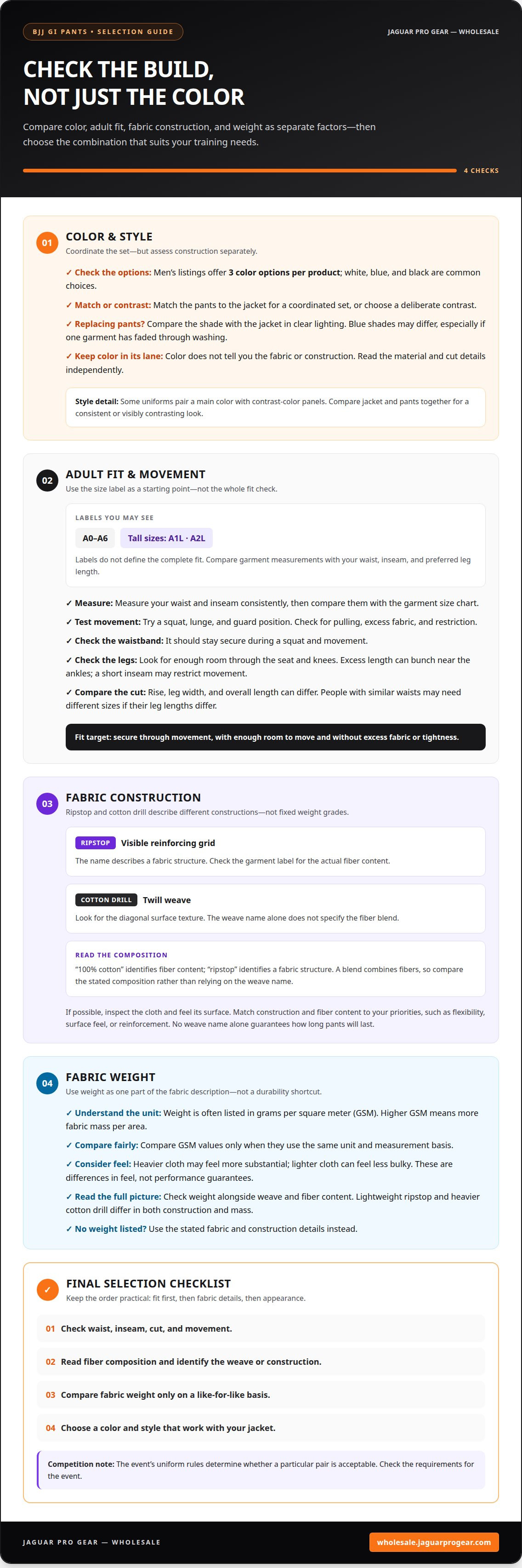
Gi pants color is only one part of the choice. Men’s listings offer three color options per product, but adult fit and fabric construction also matter. Ripstop and cotton drill are distinct options to compare, not simply color variations.
Start with fit, then consider the fabric blend and weight. Check how the cut moves during training and compare garment details before choosing. This guide explains how BJJ gi pants differ by color, style, adult fit, fabric blend, and weight. It also covers competition considerations, helping you evaluate gi pants against your training needs and event uniform requirements. Use these factors to narrow your options and make an informed choice.
Key Takeaways
- Compare color and style options against your training needs, then narrow the choice by fit.
- Use adult sizing and cut as practical selection points for a uniform that fits your build.
- Assess fabric blend and garment weight together to understand the construction options.
- For competition use, distinguish general training preferences from the event’s uniform requirements.
Colors and styles
Men’s gi listings offer three color options per product. White, blue, and black are common choices for BJJ uniforms. Match the pants to your jacket for a coordinated set, or choose a deliberate contrast. If you’re replacing only the lower garment, compare its shade with the jacket in clear lighting. A blue pair may not match every blue jacket, especially if one garment has faded through washing.
Color affects coordination, but it doesn’t describe fabric or construction. Black pants can use a lighter weave, while white pants can use heavier fabric. Read product details for material and cut rather than treating color as a performance indicator. This keeps style decisions separate from practical requirements.
Use this selection sequence:
- Choose a matching color or a planned contrast with your jacket.
- Compare the product’s listed colors, such as white, blue, or black.
- Review construction and cut independently of the color name.
Some styles use contrast-color details rather than a single-color finish. For example, a uniform may pair a main color with contrasting panels. Decide whether you prefer a consistent appearance or visible contrast, then compare the jacket and pants as a set. A blue jacket with matching pants creates a coordinated look, while contrasting details create a different visual style.
Keep fit and construction ahead of color when choosing gi pants. First, select a cut that suits your movement. Next, compare the fabric description with your training needs. Then choose a color that works with your current uniform. This order prevents appearance from becoming the only deciding factor. For a replacement pair, use the jacket’s shade and design as your reference. For a complete set, settle on the color combination before ordering your gi pants.
Each men's gi pants listing offers 3 color options per product; compare the available shades with the jacket and intended overall look before choosing.
BJJ adult gi pants
Adult sizing labels help narrow the options, but they don’t define the complete fit. Labels can include A0 through A6, with tall sizes such as A1L and A2L. Treat each label as a starting point. Compare garment measurements with your waist, inseam, and preferred leg length. This gives you a more useful basis for selecting BJJ gi pants than relying on the label alone.
Test the fit through movement, not just while standing. Check whether the waistband stays secure during a squat and whether the legs allow a full stance. The fabric shouldn’t pull sharply across your knees when you bend. Excess length can bunch near the ankles, while a short inseam may restrict movement. These checks show how adult gi pants suit your proportions.
Use this fitting sequence when comparing adult options:
- Measure your waist and inseam consistently.
- Compare your measurements with the garment size chart.
- Test a squat, lunge, and guard position for pulling or excess fabric.
- Check the waistband and leg length while moving.
Adult cuts can differ in rise, leg width, and overall length. Someone with longer legs may need a different labeled size from someone with a similar waist. A closer fit can reduce loose fabric, while enough room through the seat and knees supports movement. Prioritize measurements that affect mobility, then select the corresponding size. This makes it easier to compare adult gi pants across sizing systems.
For an adult gi set, compare the pants’ fit with the jacket’s fit and intended use. A comfortable jacket won’t prevent restriction if the trousers bind at the knees. Review adult sizing and compare the cut before selecting BJJ uniform options. Choose gi pants that stay secure through movement without excess fabric or tightness.
Fabric blends and weights
Ripstop and cotton drill describe different fabric constructions, not fixed weight grades. Compare fiber content, weave, and listed weight separately.
Fabric Blend Options
Ripstop uses a visible reinforcing grid, while cotton drill uses a twill weave. These terms describe construction, not a guaranteed fiber blend. Check the garment label for cotton, polyester, or other listed fibers. For example, “100% cotton” identifies fiber content, while “ripstop” identifies a fabric structure. A blend combines fibers, so compare its stated composition rather than relying on the weave name alone.
For a practical comparison, inspect the fabric description and feel the cloth, if possible. Look for the grid pattern associated with ripstop or the diagonal surface texture associated with drill. Then match the construction to your priorities, such as flexibility, surface feel, or reinforcement. No weave name alone determines how long a pair will last.
Fabric Weight
Fabric weight describes material mass, often shown in grams per square meter, or GSM. Higher GSM indicates more fabric mass per area, not an automatic durability rating. Compare listed values only when they use the same unit and measurement basis. If a product description gives no weight, use its stated fabric and construction details instead.
Heavier cloth may feel more substantial, while lighter cloth can feel less bulky. These are differences in feel, not guarantees of performance. Check weight alongside weave and fiber content. For example, lightweight ripstop and heavier cotton drill differ in both construction and mass, so weight alone cannot explain their feel or wear.
Use this comparison sequence before choosing:
- Read the fiber composition, then identify the weave or construction.
- Compare GSM values only when both descriptions use the same unit.
- Consider how the fabric feels during bending and leg movement.
- Choose based on the combination of blend, construction, and weight.
For BJJ gi pants, treat ripstop and cotton drill as starting points, not complete specifications. A fabric’s performance depends on its construction and fiber content together. Check those details against your training needs, then consider comfort and bulk alongside the listed material information.
Are gi pants allowed in BJJ and martial arts competitions?
For competition, the event’s uniform rules determine whether a particular pair is acceptable. BJJ and other martial arts events may set different requirements, so don’t assume one rule applies to every organizer. Check the event’s uniform instructions for the required garment type, color, fit, and condition. A pair suited to regular training may still need a closer fit or different color for a specific event.
Separate general competition suitability from fabric choice. Ripstop or cotton drill describes construction, but doesn’t establish whether an event permits that garment. For example, a pair can fit well and still fail to meet a stated color requirement. Review the organizer’s instructions first, then compare the garment against each condition. This ties your decision to the actual event rather than assumptions about fabric or style.
Before competition, use this sequence:
- Read the event’s uniform requirements, including color and garment details.
- Compare the instructions with the pants’ fit, construction, and condition.
- Try the uniform through movement, including a squat and a lunge.
- Ask your instructor to assess the fit before entering competition.
An instructor can help assess practical fit, especially leg length and excess fabric. For example, pants that bunch around the ankles or restrict a deep stance may need attention before competition. This fit check complements, but doesn’t replace, the organizer’s requirements. Use both sources: event instructions for eligibility and instructor feedback on how the uniform moves during practice.
For other martial arts competitions, avoid assuming BJJ uniform expectations apply. A karate or taekwondo event may use a different uniform format, so follow that event’s instructions instead. Keep the event name and its uniform criteria together when preparing your kit. To compare BJJ uniform options for training and competition preparation, review BJJ uniform options.
JAGUAR PRO GEAR - WHOLESALE – JAGUAR PROGEAR: Jaguar Organo - Pure Organic Cotton - Brazilian Jiu Jitsu BJJ Kimono Gi Uniform - Kids Adults Unisex IBJJF Compliant
JAGUAR PRO GEAR - WHOLESALE – JAGUAR PROGEAR offers BJJ uniforms for practitioners comparing fabric and fit. The Jaguar Organo gi is made from pure organic cotton and is IBJJF compliant, making it an option to consider for competition. The Jaguar Regular Blue gi is another choice for a blue uniform. If standard options don’t meet your requirements, Custom BJJ Gis offer a more tailored direction.
Use the product details to compare the uniform with your training needs, then assess the gi pants’ fit and construction as separate decisions. A complete gi choice involves more than fabric preference: color, adult sizing, and event requirements also matter. For a coordinated uniform or a customized option, visit JAGUAR PRO GEAR - WHOLESALE – JAGUAR PROGEAR.
Choose Your Next Training Pair with Purpose
Base your next purchase on how you train, not just how the fabric sounds on a product page. Note what matters most during practice: freedom of movement, a preferred fabric feel, or a consistent uniform setup. Use those priorities to compare options and choose a pair that fits your routine and clothing preferences.
Keep fit as a practical checkpoint. Your gi pants should support the movements you use in training without distracting excess fabric or restriction. If you’re updating a uniform or considering a different configuration, explore JAGUAR PRO GEAR - WHOLESALE - JAGUAR PROGEAR’s options, including custom BJJ gis.
Take the next step at your pace. Contact JAGUAR PRO GEAR - WHOLESALE - JAGUAR PROGEAR to explore uniform options and move forward with a choice suited to your training needs.
Frequently Asked Questions
What are gi pants?
Gi pants are the lower garment worn as part of a martial arts gi. In BJJ, they pair with a gi jacket to form the uniform used for training. Check the waistband, leg length, and freedom of movement as separate fit points. For example, see whether the legs stay clear of your feet during a stance change.
What are gi pants made of?
Gi pants are made from woven fabric, with fiber content and construction varying by garment. A label may identify cotton or a cotton blend, while a product description may name a weave such as ripstop or drill. Read both details together. When comparing pairs, check fiber content first, then consider how the fabric feels during movement and laundering.
What is the difference between gi pants and martial arts uniform pants?
Gi pants usually refers to the lower half of a gi, while martial arts uniform pants is a broader category that includes pants designed for different uniforms and disciplines. For instance, BJJ gi trousers are made to pair with a BJJ jacket. Don’t assume pants from another martial arts uniform will match a BJJ gi’s cut or requirements.
What are the best gi pants for BJJ, karate, and judo?
Choose a pair designed for your discipline and intended use. For BJJ, select pants made to pair with a BJJ gi. Karate and judo each have their own uniform categories, so choose the matching garment rather than treating all martial arts pants as interchangeable. For competition, compare the uniform with event requirements and your instructor’s fit guidance.
How do you wash and care for gi pants?
Wash gi pants in cold water with like colors, then hang dry them.